Best Time to Visit Snoqualmie Falls
Snoqualmie Falls runs strongest November to January and in May, and thinnest in August and September. Month by month: flow, weather, sunset and busy dates.
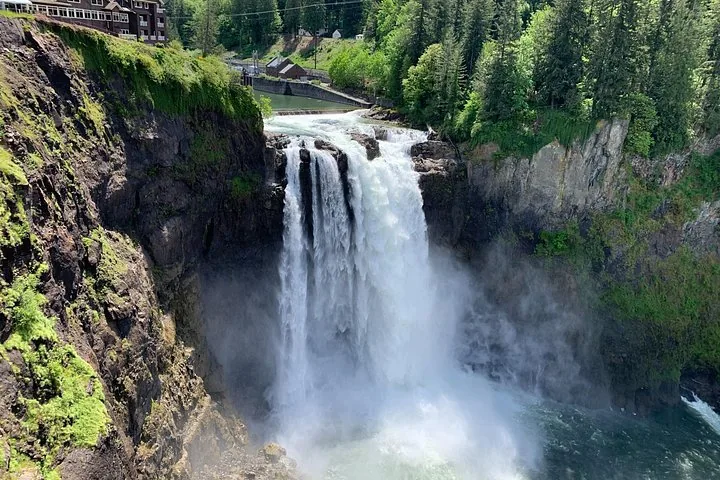
Go between November and January, or in May, if you want to see Snoqualmie Falls at full power. Those are the months when the most water goes over the 268-foot drop, and in high water the spray can hide the bottom of the gorge. August and September are the thinnest months, with about a fifth of the winter flow. June is the best balance: strong water, long dry days and a sunset after 9 pm. The park is free and open all year, so the month changes what you see, not whether you can go; the tours on our homepage run in every season.
Check Availability
Guided forest hike to Seattle waterfalls incl. Snoqualmie Falls
- 4.8/5 (680+ reviews)
- 4.5 hours
- Free cancellation
- Operated by WOW Nature Tours - Susan Hill
Includes Round-trip transport from 415 Pine St in an air-conditioned van · A guide for the hike and the whole tour · Bottled …
You'll choose your date and complete the booking on Viator. Free cancellation under Viator's standard terms; the booking page shows the deadline.
Same tour, also on GetYourGuide
From US$79 per person · ★ 4.6 from 180+ GetYourGuide reviews
Each platform sets its own price and collects its own reviews, so compare both before you book on Viator.
Best months for Snoqualmie Falls, by what you want
| If you want | Go in | Why |
|---|---|---|
| The biggest waterfall | November, December, January or May | Average flow above 3,200 cubic feet per second |
| Strong water and dry, long days | June | About 3,190 cfs, 3.2 inches of rain, sunset after 9 pm |
| A dry hike to Twin Falls as well | July or August | About 1.2 inches of rain a month, but the falls are at their thinnest |
| Autumn color | October | Leaves turning and the first heavy rain refilling the river |
| Fewer people | A weekday morning, any month | School breaks and cruise-season weekends are the busy times |
The order matters because of how short the visit is. On a combo tour you get 30 to 60 minutes at the falls; on your own, an hour on the deck or about two with the lower falls trail. In that time, rain mostly changes how wet you get. The month you pick changes how much water you are looking at, and that is what you came to see.
How the flow at Snoqualmie Falls changes through the year
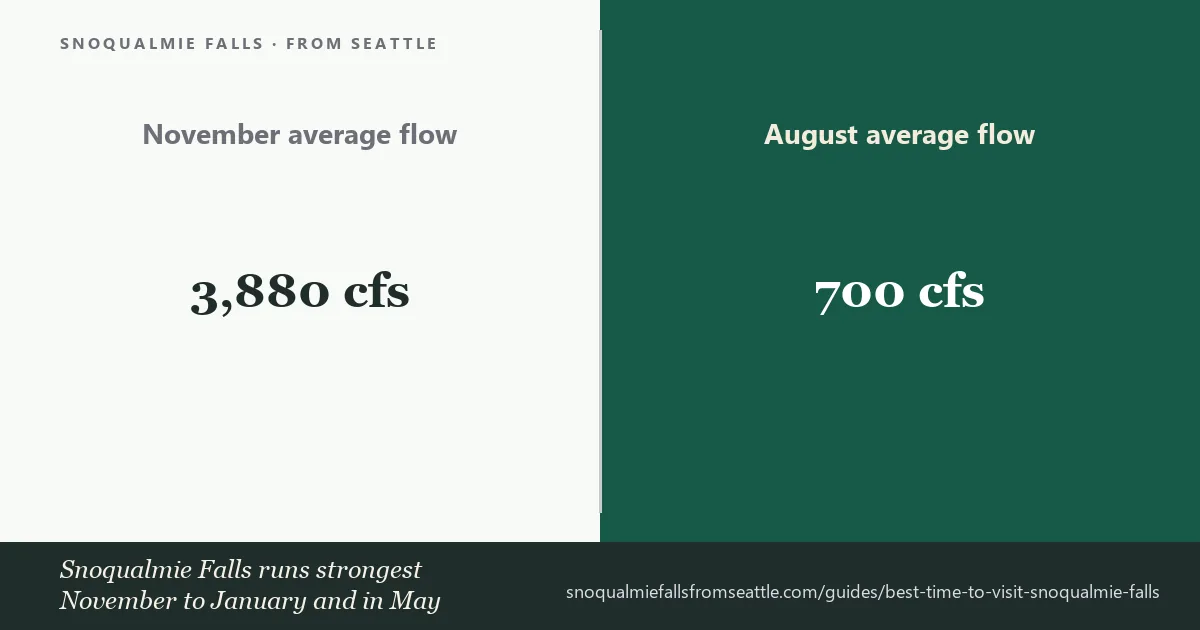
The Snoqualmie River has two high seasons. Autumn and winter rain fill it from November to January, with the highest average in November (about 3,880 cubic feet per second). Snowmelt from the Cascades brings a second peak in May (about 3,850). Then the river drops fast: July carries about half of June’s water, and August averages about 700 cfs. On USGS gauge 12144500, just below the falls, August and September run at about a fifth of the winter flow.
What that means at the railing: in winter and May the falls run as a wide white curtain and throw mist across the gorge. In late summer the water is much narrower and more of the bare cliff shows. If you are choosing a date for the waterfall alone, choose the wet months.
Averages hide single days. A heavy storm can push the river far above its monthly mean: in December 2025 the river at the falls reached a record level. A dry spell can do the opposite, and the September 2025 average fell to 288 cfs, the lowest on record for that month. The live conditions section below explains the flow reading on our homepage.
Snoqualmie Falls month by month
Typical weather at the falls, how much water goes over, and when the sun sets in Seattle, on the 15th of each month.
Jan
8.0° / 2.1°C
46/36°F. One of the strongest months for flow. Short, wet days: go in the morning.
Feb
9.8° / 1.8°C
50/35°F. Still a full curtain of water. Seattle schools' mid-winter break is 15 to 19 February 2027.
Mar
12.1° / 2.9°C
54/37°F. Clocks go forward on 14 March 2027, so the evenings jump to after 7 pm.
Apr
14.9° / 4.5°C
59/40°F. Snowmelt raises the river again. Spring break 12 to 16 April 2027; cruise season and weekend trains begin.
May
17.8° / 7.8°C
64/46°F. Snowmelt peak with milder weather. The hydro museum opened on 27 May in 2026.
Jun
20.6° / 10.3°C
69/51°F. Strong flow and long, drier days. Seattle schools finish on 21 June 2027.
Jul
24.3° / 12.2°C
76/54°F. Driest month and best for the Twin Falls trail; the falls carry about half June's water.
Aug
24.8° / 12.1°C
77/54°F. Lowest flow of the year, about a fifth of winter. Cruise-season weekends bring more visitors.
Sep
21.3° / 9.5°C
70/49°F. Still thin until the rain returns. The hydro museum closed on 6 September in 2026.
Oct
15.3° / 6.4°C
60/44°F. Autumn color and the first heavy rain; flow is more than double September's.
Nov
10.6° / 3.5°C
51/38°F. Wettest month and the highest average flow. Holiday trains start late in the month.
Dec
7.7° / 2.1°C
46/36°F. Earliest sunsets of the year. Seattle schools are off from 21 December.
Sources: Temperatures: NOAA 1991–2020 normals for the Snoqualmie Falls station, shown in °C in the cells and °F in each line. Average flow: USGS gauge 12144500, Snoqualmie River near Snoqualmie, monthly means 1991–2020. Sunset: US Naval Observatory, Seattle, on the 15th. School breaks: Seattle Public Schools 2026–27 calendar. All read November 2026.
Rain, mist and cold at Snoqualmie Falls
Snoqualmie Falls gets about 63 inches of rain a year, about 1.6 times Seattle’s total, but only about 3.6 inches of snow. November is the wettest month at 9.5 inches. Average highs run from 46°F (8°C) in January to 77°F (25°C) in August, and winter lows sit just above freezing, around 36°F (2°C). These are NOAA’s long-term averages, measured at the falls.
Rain is not a reason to stay away. The falls look biggest after rain, the deck is a short paved walk from the lot, and tours run in all weather. In high water the spray can hide the bottom of the gorge and soak a camera from the observation deck, so bring a waterproof layer, keep your phone in a pocket between photos, and stay behind the railings: the rock beyond them is wet and the drop is sheer. The lower falls trail gets muddy in the wet months, so wear shoes with grip.
Daylight and the best time of day
Seattle’s sunset is at 4:18 pm in mid-December and 4:45 pm in mid-January, so in winter book a morning tour or arrive by early afternoon. The gorge is in shade well before sunset. In June the sun does not set until 9:09 pm, which leaves room for an evening visit after a day in the city.
Mornings help in every season. The lots are emptier early in the day, and morning tours such as the Twin Falls hikes are back in Seattle by about noon. If you are coming by bus, remember that the last Route 215 back leaves the stop near the falls at about 7:15 pm on weekdays and 7:05 pm at weekends, after dark from October to February.
Busy dates at Snoqualmie Falls
No one publishes monthly visitor counts for the falls, so plan around the calendar. Seattle Public Schools’ mid-winter break (15–19 February 2027), spring break (12–16 April 2027) and winter break (21 December 2026 to 1 January 2027) bring more families. Cruise-season weekends, from mid-April to mid-October, bring more people too. PSE keeps an overflow lot by Snoqualmie Parkway for days when the main lots fill.
A weekday morning is quieter in any month. On a weekend, arrive before 10 am.
Seasonal extras and closures
- The free Snoqualmie Falls Hydroelectric Museum opens Wednesday to Sunday, 10 am to 5 pm, in summer only. The 2026 season ran from 27 May to 6 September.
- The Northwest Railway Museum’s weekend heritage trains from the Snoqualmie Depot run up to the top of the falls from April to September (about 2 hours round trip), with holiday trains on late-November and December weekends.
- The Twin Falls hike near North Bend is at its driest in July and August. The Lower Falls Viewpoint on the Twin Falls trail has been closed since March 2026 after storm damage; check parks.wa.gov.
- PSE closed the lower boardwalk at Snoqualmie Falls between Labor Day and Memorial Day in past winters. Its status for winter 2026–27 is not confirmed, so check PSE before you plan the lower falls trail between September and May.
The winter guide covers the cold months in more detail, and the free entry and parking guide has the park hours and which lots charge.
Live conditions at the falls
The strip at the top of our homepage shows four things about the falls today. Each comes from a public source, and you can check it yourself.
- Falls flow now. The live reading from USGS gauge 12144500, Snoqualmie River near Snoqualmie, just below the falls, in cubic feet per second, compared with the long-term average for the month. Below 0.6 times the average reads “Low”, 0.6 to 1.4 times “About average”, 1.4 to 3 times “High”, and above 3 times “Very high, flood flow”. USGS data is a US government work in the public domain. On 20 November 2026 the gauge read about 800 cfs, around a fifth of the November average, a reminder that a wet month can still have a thin day.
- Forecast. The current period from the NOAA / National Weather Service forecast for the falls (api.weather.gov), also public domain.
- Weather alerts. Any active National Weather Service alert for the falls appears as a line under the strip; when there is none, the line is hidden.
- Sunrise and sunset. Computed in your browser for Snoqualmie with NOAA’s solar equations, Pacific time.
Your browser refreshes the flow, forecast and alerts when you open the page. If a source is down, the strip shows the last reading saved when the site was built.
The strip never says whether a tour is running. The park is open in daylight all year, and in rain, wind or high water the operator decides on the day whether a tour goes ahead and in what order the stops come. If the weather looks bad, check your booking and the operator’s messages.
Frequently asked questions
What is the best month to see Snoqualmie Falls?
For the biggest flow, November to January or May. For strong flow with long, dry days, June, at about 3,190 cfs. August and September are the thinnest months, with about a fifth of the winter flow.
Can you visit Snoqualmie Falls in the rain?
Yes. The falls look biggest after rain, the observation deck is a short paved walk from the lot, and tours run in all weather. Bring a waterproof layer for the spray.
When is Snoqualmie Falls least crowded?
On weekday mornings. School breaks and cruise-season weekends, mid-April to mid-October, are the busiest times.
Is Snoqualmie Falls worth visiting in summer?
Yes, but expect a thinner waterfall: August averages about 700 cfs against about 3,880 in November. Summer is the best time for the Twin Falls hike and the hydroelectric museum.
What time of day is best for Snoqualmie Falls?
Morning. In winter the sun sets by about 4:20 to 4:45 pm, and in every season the lot is emptier early in the day.
Book a Snoqualmie Falls tour for your dates
The forest hike above runs in rain or shine; check availability for your dates, or compare every tour on the Snoqualmie Falls tours page.
Check Dates for the Seattle City & Snoqualmie Falls Tour
A morning from Pike Place Market with a guide and transport: Snoqualmie Falls plus Seattle viewpoints, back by early afternoon. The falls are free to visit, so the price pays for the transport and the guide. Check dates and the cancellation deadline on Viator.
Check Availability